Quick Answer: How Many Miles Do Tires Last?
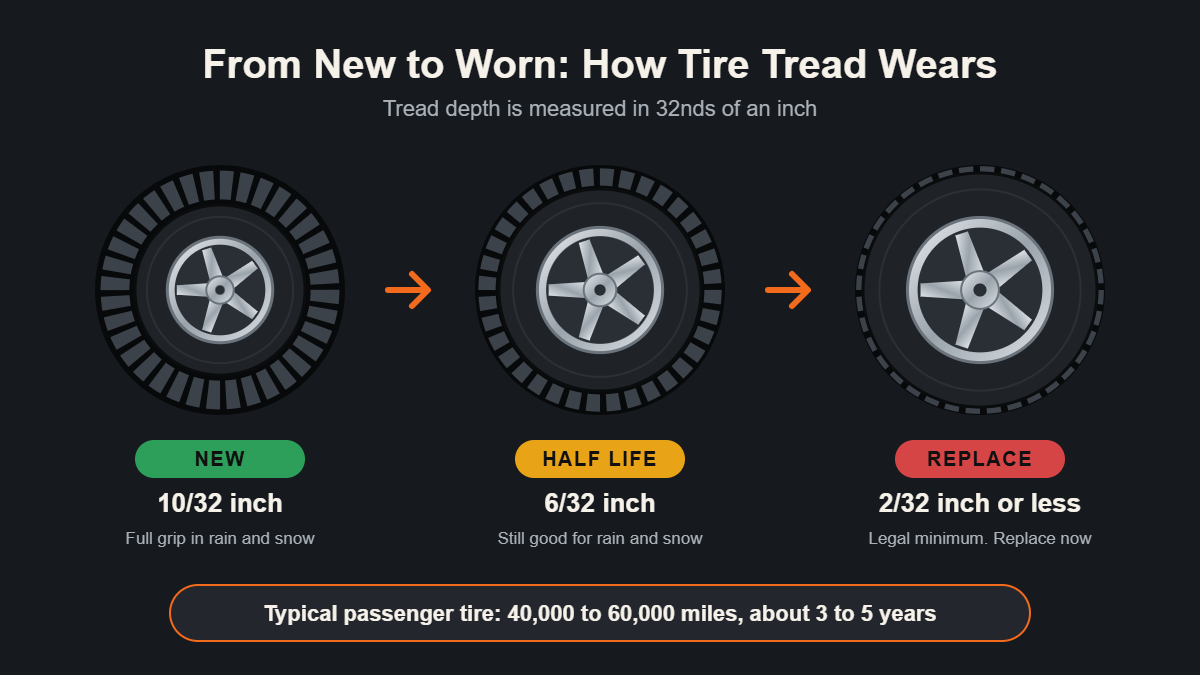
How many miles do tires last? Most passenger car tires last 40,000 to 60,000 miles, which works out to about 3 to 5 years for the average American driver putting on 12,000 to 15,000 miles a year. Premium touring tires can reach 70,000 to 80,000 miles. Performance and winter tires often wear out by 20,000 to 40,000 miles.
Mileage is only half the story. Rubber ages even when tread looks fine, so most tire makers and safety groups say to inspect tires every year after year 5 and replace them by about year 6 to 10, no matter the mileage.
Why This Question Matters More Than You Think
Your tires are the only part of your car that touches the road. Four contact patches, each about the size of your hand, handle every stop, turn and swerve.
At A&G Tire Service in Des Moines and Ames, Iowa, we see the same story every week. A driver bought “60,000-mile tires” and is shocked to need new ones at 32,000. That gap between the number on the warranty and the number on your odometer is what this guide explains.
You will learn how long each tire type really lasts, what a treadwear warranty actually promises, why some tires die early, and how to squeeze every safe mile out of your next set.
How Many Miles Do Tires Last by Type
The type of tire you buy sets the ceiling on its mileage. Soft rubber grips better but wears faster. Hard rubber lasts longer but gives up some grip, especially in the cold.
| Tire type | Typical tread life (miles) | Typical warranty | Best for |
|---|---|---|---|
| Touring / grand touring | 60,000 to 80,000 | 60k to 80k | Sedans, minivans, highway commuters |
| Standard all-season | 50,000 to 70,000 | 45k to 70k | Everyday cars and crossovers |
| Highway-terrain (H/T) truck & SUV | 50,000 to 70,000 | 50k to 70k | Pickups and SUVs on pavement |
| All-terrain (A/T) | 40,000 to 60,000 | 40k to 60k | Gravel roads, light off-road |
| Original equipment (OEM) | 25,000 to 45,000 | Often none or low | Tires that came on a new car |
| Performance / UHP all-season | 30,000 to 45,000 | 30k to 50k | Sporty cars |
| Summer / max performance | 15,000 to 30,000 | Usually none | Warm-weather track and sport driving |
| Mud-terrain (M/T) | 25,000 to 45,000 | Often none | Serious off-road |
| Winter / snow | 3 to 4 seasons (often 20k to 40k total) | Often none | Iowa winters, ice and snow |
| EV-specific tires | 30,000 to 50,000 | Varies | Teslas, F-150 Lightning, Ioniq 5 |
Ranges reflect industry averages from Mavis and published manufacturer warranties. Your own result will vary with driving, maintenance and roads.
Why OEM Tires Wear Out So Fast
The tires on a brand-new car are chosen to hit fuel-economy, comfort and handling targets, not to last. That is why many drivers need their first replacement set at 25,000 to 40,000 miles and then get far more from the next set.
Commercial, Semi and Farm Tires Play by Different Rules
Most tire guides stop at cars. Commercial tires are built with steel casings meant to run hundreds of thousands of miles and then be retreaded.
| Position | Typical original tread life | Federal minimum tread |
|---|---|---|
| Steer tires | About 100,000 to 150,000 miles | 4/32 inch |
| Drive tires | Roughly 250,000 to 500,000 miles in long-haul use | 2/32 inch |
| Trailer tires | About 200,000 to 325,000 miles | 2/32 inch |
Regional and local work, with more turning and stopping, sits at the low end of these ranges (SlashGear, Tire Review). Farm and ag tires are usually judged by hours and lug wear, not miles. Road travel at speed is what wears tractor lugs fastest.
Treadwear Warranty vs. Real-World Mileage
A treadwear warranty is a promise with fine print, not a prediction. It tells you the most the maker will stand behind if you follow every rule.
Most mileage warranties require proof of rotation about every 5,000 to 8,000 miles, correct inflation, a proper alignment and even wear across the tread. If one tire wears out early from a bad alignment, the claim is usually denied. When a claim is approved, credit is almost always prorated, so you get a discount on a new tire, not a free one.
What the UTQG Treadwear Number Means
Look on the sidewall for a code like “TREADWEAR 600 A A.” This is the Uniform Tire Quality Grading (UTQG) system set up by the National Highway Traffic Safety Administration (NHTSA).
The treadwear number compares a tire to a government reference tire that scores 100. In theory a 600 tire wears three times longer than the reference. But the grade is a ratio, not a mileage, and each brand assigns its own grade, so it is most useful for comparing tires within one brand (UTQG overview).
| UTQG treadwear | Rough real-world expectation |
|---|---|
| 200 to 300 | Performance tire, often under 35,000 miles |
| 400 to 500 | Average all-season, roughly 40,000 to 55,000 miles |
| 600 to 700 | Long-life touring, roughly 60,000 to 70,000 miles |
| 800+ | Top longevity tires such as the Michelin Defender2 (UTQG 840) |
The traction grade (AA, A, B, C) measures wet straight-line braking. The temperature grade (A, B, C) measures heat resistance. Neither one tells you mileage.
The Age Rule: Tires Expire Even With Tread Left
Rubber breaks down from heat, sunlight, ozone and time. Cracks can form inside the tire before you ever see them outside.
Michelin recommends a professional inspection every year once a tire has been in service for 5 years, and replacement by 10 years from the manufacture date, spares included. Many carmakers set a shorter limit of 6 years, so check your owner’s manual.
How to Read the DOT Date Code
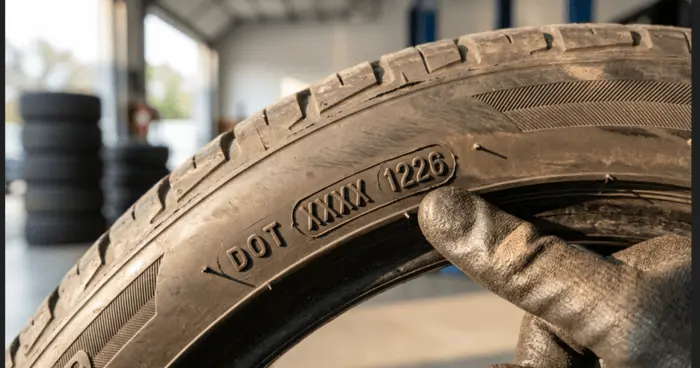
Find the letters “DOT” on the sidewall. The last four digits are the week and year the tire was built.
A code ending in 3520 means week 35 of 2020. Some guides get this wrong and say the first two digits are the month. They are the week.
What Wears Tires Out Faster
Two drivers can buy the same tire and get 35,000 miles and 75,000 miles. These are the factors that create that gap.
Tire Pressure
Underinflation is the quiet tire killer. A soft tire flexes more, runs hotter and wears both outer shoulders. Overinflation does the opposite and wears the center strip.
In cold weather, tire pressure drops about 1 PSI for every 10°F fall in temperature. An Iowa cold snap can leave tires 4 to 5 PSI low overnight.
Wheel Alignment
A car that is out of alignment drags its tires sideways a tiny bit with every turn of the wheel. That scrubbing wears one edge in a hurry. Hitting a pothole or curb is often enough to knock alignment out.
Rotation and Balance
Front tires on a front-wheel-drive car steer, brake and pull, so they wear faster than the rears. Rotation every 5,000 to 7,500 miles spreads that wear out. An unbalanced wheel causes vibration and cupped, scalloped tread.
Driving Habits
Hard launches, fast cornering and late braking all scrub rubber off. Smooth, steady driving can add thousands of miles to a set.
Vehicle Weight and Load
Heavier vehicles wear tires faster. Towing, hauling and running near the tire’s maximum load all shorten tread life, so match the load index to how you actually use the truck.
Electric Vehicles
EVs are heavy and deliver full torque instantly. Several tire makers and testers report EVs wearing tires roughly 15 to 30 percent faster than similar gas cars, and Science Friday cites about 20 percent from tire testing. EV-rated tires with tougher compounds help.
Roads and Climate in Central Iowa
Central Iowa is hard on tires in ways a sunny-state blog will not mention. Freeze-thaw cycles open potholes on I-35, I-80 and city streets every spring. Gravel and chip-seal county roads chew tread and cut sidewalls. Road salt, summer heat on the pavement and big temperature swings all speed up rubber aging.

Wrong Tire for the Season
All-season rubber starts stiffening below about 45°F, according to Michelin. Running soft winter tires through a hot July burns them up fast. Swapping seasonal sets at the right time protects both.
Your Tire Mileage Questions, Answered
These are the questions drivers type into Google most often. Each answer starts with the short version.
Is 20,000 miles a lot on tires?
No. For most all-season tires, 20,000 miles is less than halfway through their life. You likely have 50 to 70 percent of your tread left.
The exception is summer performance tires and soft winter tires. For those, 20,000 miles can be close to the end. Check the tread depth and look for uneven wear to be sure.
Is 30,000 miles good for a set of tires?
It depends on the tire. For OEM tires, performance tires or a heavy EV, 30,000 miles is normal and even decent. For a standard all-season or touring tire, it is below average.
If a tire with a 60,000-mile warranty is worn out at 30,000, something sped up the wear. That leads to the next question.
Why did my tires only last 30,000 miles?
The usual causes are skipped rotations, low tire pressure, a bad alignment, or tires that came on the car from the factory. Hard driving, heavy loads, EV torque and rough roads add to it.
Look at the wear pattern for clues:
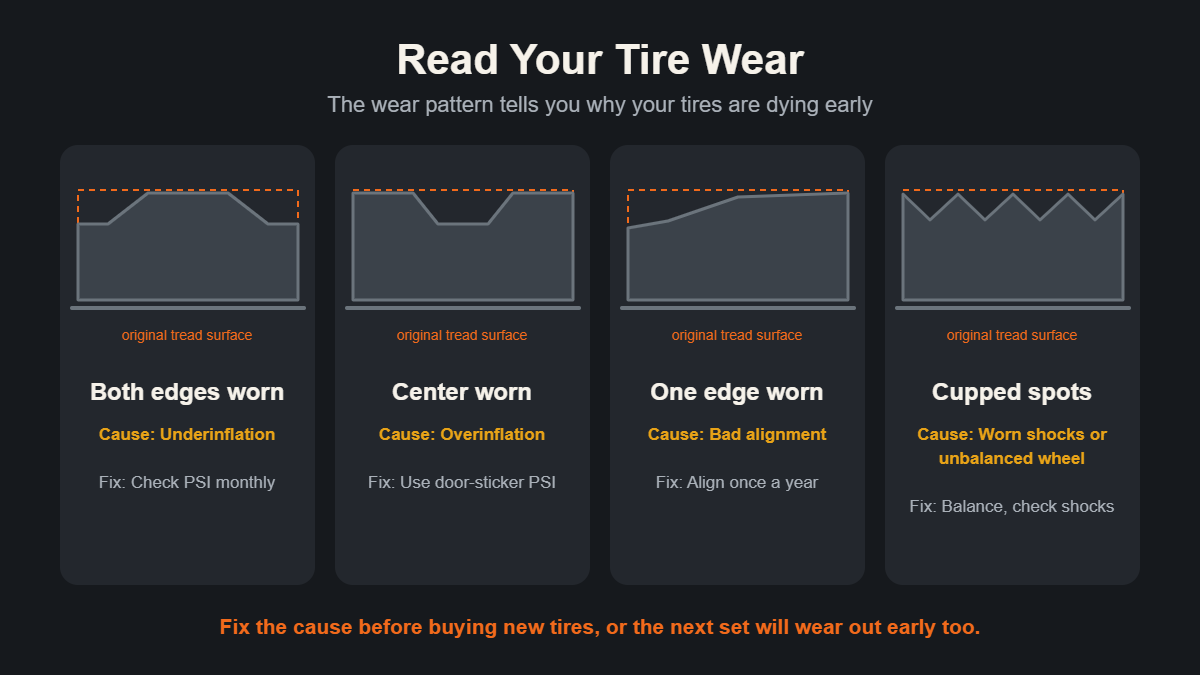
- Both edges worn: underinflation
- Center worn: overinflation
- One edge worn: alignment (camber or toe)
- Cupped or scalloped spots: worn shocks, struts or an unbalanced wheel
- Front tires much more worn than rears: no rotations
Fix the cause before buying new tires, or the next set will die early too.
Are 40,000-mile tires good?
Yes, for the right driver. A 40,000-mile tire is usually a budget or performance option. It costs less up front and often grips better.
If you drive 15,000 miles a year, 40,000 miles is under 3 years of use. High-mileage commuters usually save money with a 60,000 to 80,000-mile tire because the cost per mile is lower.
Can tires last 50,000 miles?
Yes. 50,000 miles is right in the normal range for a quality all-season tire. With monthly pressure checks and regular rotations, most mid-range and premium all-season tires reach or pass it.
Can tires last 70,000 miles?
Yes, but you need a long-life touring or highway tire, a lighter vehicle, mostly highway miles, and good maintenance. Tires such as the Michelin Defender2, Bridgestone Turanza and Goodyear Assurance MaxLife lines are built for this range.
Can tires last 100,000 miles?
Rarely, and usually not safely on a passenger car. Very few car tires carry a 100,000-mile warranty, and even gentle highway drivers take 7 or more years to cover that distance. By then the rubber is aging out.
Commercial truck tires are different. Steer, drive and trailer tires on semis routinely pass 100,000 miles, and their casings can be retreaded for more.
Do Michelin tires really last 80,000 miles?
Some can. The Michelin Defender2 carries an 80,000-mile treadwear limited warranty, a 6-year limited warranty and a very high UTQG grade of 840. Many careful highway drivers get close to 80,000.
Not every Michelin is an 80,000-mile tire, though. Pilot Sport performance tires and X-Ice winter tires last far less. To claim the warranty you will need rotation records, correct inflation and even wear, and any credit is prorated.
Is it better to replace all 4 tires?
Usually yes. Four matching tires give the most balanced grip, braking and handling, and it is the ideal Michelin recommends.
On AWD and 4WD vehicles it matters most. A new tire is taller than a worn one, so it spins at a different speed, which strains the center differential and transfer case. A common guideline is to keep all four tires within about 2/32 inch of tread depth, per Discount Tire. Some carmakers allow a little more, so check your manual.
On a two-wheel-drive car, replacing two is fine if the other pair still has good tread. Put the new pair on the rear axle for better wet-road stability. If only one tire is damaged and the rest are nearly new, a single matching tire, or one shaved to match, can work.
How to Tell If Your Tires Are Worn Out
Miles and years are guides. Tread depth and condition are the final word. New passenger tires start with about 10/32 to 11/32 inch of tread. Most light-truck and all-terrain tires start deeper.
| Tread depth | What it means |
|---|---|
| 6/32 inch or more | Good for rain and snow |
| 4/32 inch | Start shopping; wet and snow grip falls off quickly below here |
| 2/32 inch | Legal minimum in most states; replace now |
The Penny and Quarter Tests
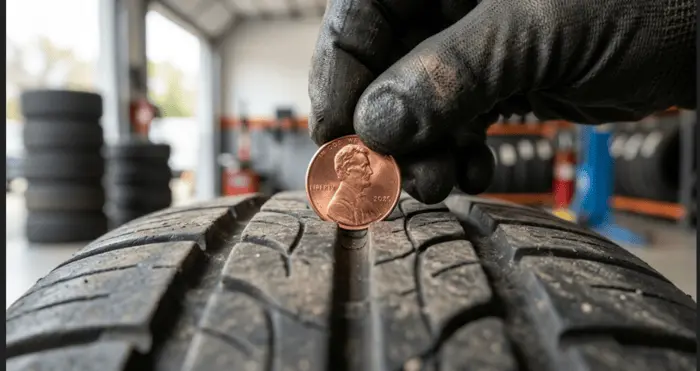
- Put a penny in the tread groove with Lincoln’s head upside down. If you can see the top of his head, you are at 2/32 inch or less.
- Try a quarter the same way. If you can see the top of Washington’s head, you are at 4/32 inch or less.
- Check the inner, middle and outer grooves on every tire. Uneven readings point to pressure or alignment problems.
You can also look for the small rubber wear bars molded across the grooves. When the tread is flush with them, the tire is done.
Warning Signs Beyond Tread Depth
- Bulges or bubbles on the sidewall
- Cracks in the sidewall or between tread blocks (dry rot)
- Cuts deep enough to show cords or steel belts
- New vibration, pulling or a thumping sound
- A TPMS light that keeps coming back on
- A tire older than 6 to 10 years, even with good tread
Any sidewall bulge or cut means stop driving on that tire. Sidewall damage cannot be repaired. Tread punctures are a different story, and many can be patched safely. Here is how long a tire patch takes.
How to Make Your Tires Last Longer
The good news: the biggest factors are in your control. Follow this simple routine and most tires will reach or beat their rated mileage.
- Check tire pressure once a month and before long trips, with the tires cold. Use the number on the driver’s door sticker, not the max PSI on the sidewall.
- Rotate tires every 5,000 to 7,500 miles, or with every oil change. Keep the receipts for your warranty.
- Get an alignment check once a year and after any hard pothole or curb hit.
- Balance wheels when you feel vibration or after a tire repair.
- Stay within your tire’s load index when towing or hauling.
- Drive smoothly: ease off at stoplights, slow before corners, avoid jackrabbit starts.
- Swap to winter tires when temperatures stay below 45°F and back in spring.
- Store off-season tires cool, dry and out of sunlight, away from motors and ozone.
- Fix slow leaks fast. Driving even a few miles on a badly underinflated tire can ruin it internally.
For fleets, farms and semis, add a pre-trip walk-around and a weekly gauge check. Low pressure on one dual can overload its partner without anyone noticing.
How Many Years Will Your Tires Last?
Divide the tire’s expected mileage by the miles you drive each year. Then cap the answer at the age limit, whichever comes first.
| Miles you drive per year | 40,000-mile tire | 60,000-mile tire | 80,000-mile tire |
|---|---|---|---|
| 8,000 | 5 years | 7.5 years | 10 years (at the age limit) |
| 12,000 | About 3.3 years | 5 years | About 6.7 years |
| 15,000 | About 2.7 years | 4 years | About 5.3 years |
| 20,000 | 2 years | 3 years | 4 years |
Low-mileage drivers can hit the 6-to-10-year age limit before the tread wears out. An 80,000-mile tire pays off most for drivers covering 12,000 miles a year or more.
Cost Per Mile: The Smarter Way to Shop
The cheapest tire is not always the least expensive. Compare cost per mile instead of sticker price.
For example, a $560 set rated for 40,000 miles costs 1.4 cents per mile. A $880 set that lasts 80,000 miles costs 1.1 cents per mile. These are sample prices to show the math, so plug in real quotes for your size.
Factor in installation, balancing and alignment too. Paying for an alignment at install time is cheap insurance for a long-life tire.
Get Your Tires Checked in Des Moines or Ames
Not sure how many miles your tires have left? A&G Tire Service can measure your tread, check the DOT date, read the wear pattern and tell you honestly whether you need new tires yet.
We service cars, pickups, SUVs, semis, trailers and farm equipment, at our shops or on the side of the road, 24 hours a day, 7 days a week. See examples of our recent work in our photo gallery.
- Des Moines: 4300 NE 28th St, Des Moines, IA 50317 · (515) 537-9524
- Ames: 410 Freel Dr Unit 3, Ames, IA 50010 · (515) 858-6442
Contact A&G Tire Service to book tire repair, mounting, balancing or 24/7 roadside help.
More Tire Tips From A&G Tire Service
- How Long Does It Take to Patch a Tire? A real-world guide from Iowa’s mobile tire pros
- What Does “Service Tire Monitor System” Mean? Causes, fixes and costs
- Our tire services: repair, mounting, balancing, new tire sales and 24/7 roadside help
- More tire advice on the A&G Tire blog