Quick answer: A proper tire patch takes about 30 to 60 minutes. A quick plug takes 10 to 20 minutes. At a shop, your total time may stretch to 1 to 2 hours once you count the drive and the wait. With mobile tire service, the technician comes to you, so the only waiting is for them to arrive and do the repair.
That nail in your tread always shows up at a bad moment: before work, on I-35 at night, or in a parking lot outside Jack Trice Stadium. The first question everyone asks is, “How long is this going to take?”
Below, we break down where every minute goes. We also explain what can slow things down and answer the questions Iowa drivers ask us most.
Tire Repair Time at a Glance
Different repair methods take different amounts of time.
| Repair Method | Typical Time | Permanent? |
|---|---|---|
| Tire sealant (aerosol can) | 5–10 min | No, emergency only |
| Plug only (from outside) | 10–20 min | No, temporary |
| Patch only (from inside) | 25–40 min | Not recommended alone |
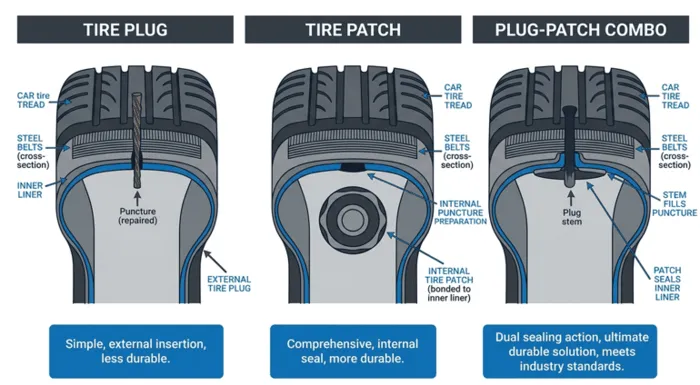
| Plug-patch combo (from inside) | 30–60 min | Yes, the industry standard |
| Spare tire swap | 15–30 min | No, the spare is temporary |
Where the Minutes Actually Go
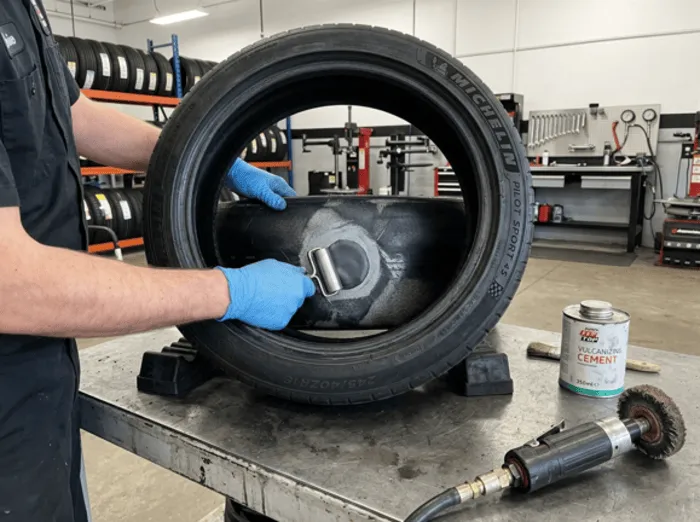
A step-by-step look at a professional plug-patch repair.
A correct repair is more than “stick a patch on it.” This is what a trained technician does, and roughly how long each step takes:
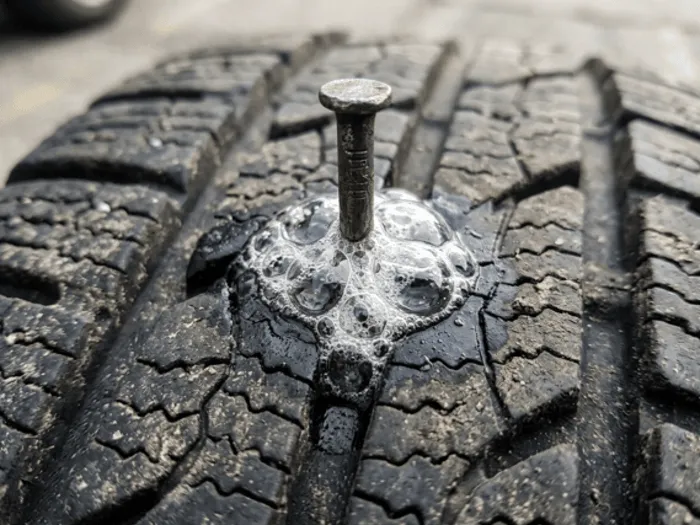
- Find the leak (2–5 min). The tech sprays soapy water on the tire and watches for bubbles. A slow leak from a tiny screw can take longer to find.
- Dismount the tire (5–10 min). The tire comes off the wheel. This is the only way to inspect the inside, and many drivers don’t know that.
- Inspect inside (3–5 min). The tech checks the inner liner for damage from driving on low pressure. A tire that looks fine from outside can be ruined inside.
- Clean and prep the hole (5–10 min). The tech drills out the puncture channel, then buffs and cleans the inner liner so the patch bonds.
- Apply cement and let it set (3–10 min). Vulcanizing cement has to get tacky before the patch goes on. In an Iowa winter this step takes longer, because cold rubber and cold cement set slowly.
- Install the plug-patch (5 min). The stem fills the hole and the patch seals the liner. The tech then rolls it firmly so it bonds completely.
- Remount, inflate and balance (10–15 min). The tire goes back on the wheel and is set to the correct PSI. The tech balances the wheel and checks the TPMS sensor and valve stem.
Total: about 30 to 60 minutes of real work.
Why Shop Visits Take Longer Than the Repair
Hidden time is the part no one tells you about.
The repair itself is under an hour, but a shop visit often isn’t. Here is what eats the rest of your time:
- Getting there. You first have to put on your spare or inflate the tire, then drive across town.
- The queue. Walk-in flat repairs often wait behind scheduled oil changes and alignments.
- Shop hours. A flat at 11 p.m. on a Sunday usually means waiting until Monday morning.
This is where 24/7 Mobile Tire Service & Roadside Assistance in Des Moines & Ames, IA changes things. A mobile technician comes to your driveway, office lot or the roadside with the tools to repair the tire there. You don’t have to tow, drive on a damaged tire, or sit in a waiting room.
What Can Slow Down a Tire Patch?
Some repairs take longer than average, and these are the reasons.
- Cold weather. Below freezing, cement takes longer to cure. Frozen tire beads are also harder to break loose from the rim.
- Low-profile or run-flat tires. Stiff sidewalls are slower to dismount and remount.
- Hard-to-find leaks. Bead leaks, valve stem leaks and corroded rims can look like punctures.
- Several punctures. Each hole is prepped and patched on its own, as long as they’re far enough apart.
- Large tires. Semi-truck, trailer and tractor tires are heavier and need special equipment. Expect anywhere from 45 minutes to a couple of hours, depending on the tire and where the truck is.
Can Every Tire Be Patched?
The industry repair rules, explained simply.
U.S. Tire Manufacturers Association guidelines set clear limits. A tire is usually repairable if all of these are true:
- The puncture is ¼ inch (6 mm) or smaller.
- It’s in the tread area, not the sidewall or shoulder.
- It doesn’t overlap an earlier repair.
- The tire wasn’t driven flat long enough to damage the inner liner.
- There’s still enough tread, above 2/32 inch, which is the legal minimum in most states.
If any of these fail, the safe answer is a new tire, even if a patch would technically hold air.
People Also Ask: Your Tire Patch Questions Answered
How long can I drive on a patched tire?
A proper repair lasts as long as the tire does.
A professional plug-patch from the inside is a permanent repair. You can drive on it for the rest of the tire’s tread life. A plug alone from the outside is different: treat it as temporary and get the tire properly repaired soon.
Is it better to plug or patch a tire?
The best choice is neither one alone, but both together.
A plug fills the hole but doesn’t fully seal the inner liner. A patch seals the liner but leaves the hole open, so water can reach the steel belts and cause rust. The plug-patch combination does both jobs, which is why tire manufacturers recommend it.
Can I drive 2 hours with a nail in my tire?
It’s possible, but it isn’t a smart gamble.
A nail sometimes plugs its own hole for a while. But two hours at highway speed builds heat, and the nail can shift or work loose. If the tire then deflates, you risk sidewall damage that makes it impossible to repair. Check the pressure, keep your speed down, and get it repaired before a long drive. Better yet, have a mobile tech come to you first.
How long should I wait after patching a tire?
In most cases, you don’t need to wait at all.
A professional plug-patch is cured and pressure-tested before you leave, so you can drive right away. It’s a good habit to check the tire pressure again within 24 hours. That confirms the repair is holding.
Can a patched tire cause a blowout?
A proper repair rarely fails, but a bad one can.
Blowouts after a repair usually come from one of four problems: a sidewall repair that never should have been done, a puncture that was too large, a tire that was driven flat before the repair, or a plug-only repair that loosened. When the repair follows industry rules, the tire is just as safe as an unrepaired one.
Can I drive 1 mile on a popped tire?
Stop driving as soon as you safely can.
Even a short distance on a flat crushes the sidewall, damages the inner liner, and can bend or crack your rim. A $30 repair can turn into a new tire plus a wheel. Pull over somewhere safe, turn on your hazard lights, and call for roadside tire assistance.
How much does it usually cost to patch a hole in a tire?
Most shop repairs cost $20 to $60.
A standard plug-patch at a shop usually costs between $20 and $60, depending on the tire size and your area. Mobile and after-hours service includes a service call charge, but it often costs less than a tow plus a shop visit. Commercial and farm tire repairs are priced separately. Call for an exact quote for your vehicle.
Can you patch a tire yourself?
You can plug a tire yourself. A real patch is much harder.
A DIY plug kit can get you home in an emergency. A proper patch requires removing the tire from the wheel, inspecting the inside, buffing, using cement, and rebalancing, and most people don’t have the equipment for that. A DIY plug should only be a stopgap until a pro can do the full repair.
How do I know if I need a patch or a new tire?
Check the location, the size of the damage, and the tire’s condition.
You likely need a new tire in any of these cases:
- The damage is in the sidewall or shoulder.
- The hole is larger than ¼ inch.
- There’s a bulge, bubble or cut.
- The tire was driven flat.
- The tread is worn to 2/32 inch or less.
A small nail or screw hole in the tread of a healthy tire can almost always be patched.
Fast Tire Repair in Des Moines, Ames and Central Iowa
A&G Tire Service comes to you, day or night.
A&G Tire Service provides 24/7 Mobile Tire Service & Roadside Assistance in Des Moines & Ames, IA, plus surrounding communities like Ankeny, Altoona, Urbandale, West Des Moines, Nevada and Boone. Our technicians handle:
- Passenger car, SUV and pickup flat repairs at your home or work
- Emergency roadside tire service on I-35, I-80, US-30 and Highway 65
- Semi-truck and trailer tire repair and replacement for drivers passing through
- Agricultural tire service for Iowa farms
- Commercial fleet tire support to keep your vehicles on the road
Visit us:
- Ames: 410 Freel Dr, Unit 3, Ames, IA 50010
- Des Moines: 4300 NE 28th St, Des Moines, IA 50317
Call (515) 537-9524, any hour. Tell us where you are and what happened, and we’ll take care of the rest.