
“Service Tire Monitor System” means your car’s tire pressure monitoring system (TPMS) has a fault and can no longer check your tire pressure reliably. It does not usually mean a tire is low. The most common causes are a sensor with a dead battery, a damaged sensor, or sensors that weren’t relearned after a tire rotation or replacement.
You’ll see this message mostly on GM vehicles such as Chevrolet, GMC, Buick, and Cadillac. Other brands show the same problem as a TPMS light that flashes, then stays on. Below, the team at A&G Tire Service in Des Moines explains what causes it, whether it’s safe to drive, what the fix costs, and how we repair it.
Service Tire Monitor System vs. the Low Tire Pressure Warning
These two warnings look similar but mean different things. The low pressure warning is about your tires. The service message is about the system that watches them.
| Low tire pressure warning | Service Tire Monitor System | |
|---|---|---|
| What it means | One or more tires are underinflated | The TPMS itself isn’t working correctly |
| How the light behaves | Comes on and stays on (solid) | Flashes for about a minute, then stays on |
| Usual fix | Inflate tires to the pressure on your door-jamb sticker | Diagnose and repair or replace a sensor, or relearn the sensors |
| Goes away after adding air? | Yes, usually after a short drive | No |
If you add air and the message is still there, the problem is almost certainly the monitoring system, not the tires.
What Causes the Service Tire Monitor System Message?
Each wheel on your vehicle has a small battery-powered sensor inside the tire. It sends pressure readings to your car’s computer by radio. The message appears when that communication breaks down. Here are the most common reasons we see at our shop:
- Dead sensor battery. The batteries are sealed inside the sensor and can’t be replaced on most designs. They typically last 7 to 10 years, so this is the top cause on older vehicles.
- Damaged sensor. Potholes, curbs, and careless tire changes can crack a sensor or break its valve stem.
- Sensors not relearned. After a tire rotation, new tires, or a sensor swap, the car may need to relearn which sensor sits at which wheel.
- Wheels without sensors. A spare tire or a second set of winter wheels without sensors will trigger the message.
- Corroded valve stem. Iowa road salt corrodes aluminum valve stems and sensor hardware, which can cause leaks and sensor failure.
- Receiver or module fault. Less often, the part of the car that receives sensor signals has a problem.
Is It Safe to Drive with This Message On?
Yes, in most cases you can drive short-term, as long as your tires are properly inflated. The message doesn’t affect your brakes, steering, or engine.
The risk is what you lose. With the system down, your car can’t warn you about a slow leak or a tire going flat. Driving on an underinflated tire wears it fast, hurts handling and braking, and can lead to a blowout at highway speed.
Until it’s fixed, check all four tires with a gauge at least once a week and before any long drive. Get the system repaired soon, especially before winter, when cold weather drops tire pressure.
What You Can Check Yourself First
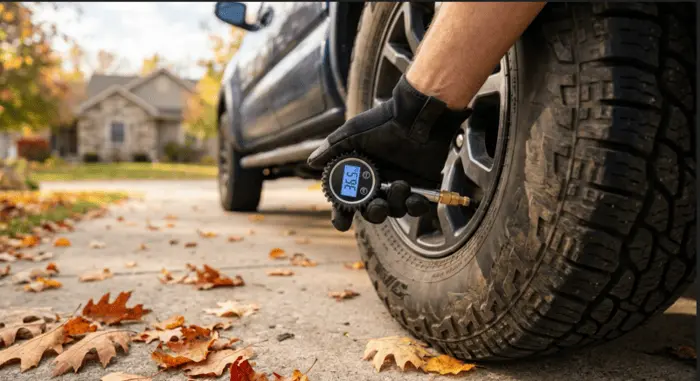
Before booking a repair, a few quick checks can save you time:
- Check all four tires with a gauge. Set them to the pressure on the sticker inside your driver’s door, not the number on the tire sidewall.
- Drive for 10 to 20 minutes. Some systems need a short drive above about 20 mph to recheck the sensors.
- Think about recent tire work. If your tires were just rotated or replaced, the sensors may only need a relearn.
- Check for a wheel without a sensor. If you’re driving on a spare or a second set of wheels, that explains the message.
If the message is still on after these steps, a sensor or the system needs professional diagnosis.
How A&G Tire Service Fixes It
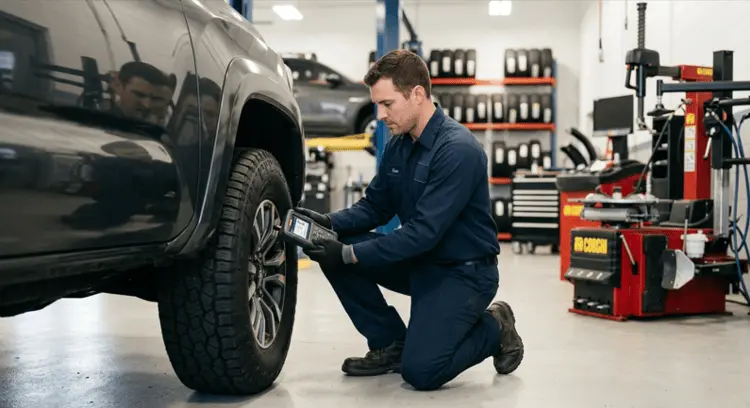
We don’t guess or replace parts you don’t need. Here’s our process:
- Scan the system. A TPMS scan tool reads each sensor and shows which one is offline, has a low battery, or is sending bad data.
- Inspect the tires and valve stems. We check for leaks, damage, and corrosion.
- Repair or replace the faulty sensor. If a sensor is dead or damaged, we dismount the tire, install a new sensor with a fresh valve service kit, then remount and balance the tire.
- Relearn the sensors. We program the new sensor to your vehicle so the system knows its position.
- Confirm the fix. We make sure the warning is cleared and all four tires report correctly.
If your vehicle is 7 to 10 years old and still has its original sensors, we’ll tell you whether replacing all four at once makes more sense. It usually costs less than paying for the same labor again when the next one fails.
Frequently Asked Questions
Is it okay to drive with a Service Tire Monitor System message on?
Yes, for a short time, if you check your tire pressure manually. The car drives normally, but it can no longer warn you about a low or leaking tire. Check all four tires with a gauge weekly and get the system repaired soon.
How can I fix a Service Tire Monitor System?
First, set all tires to the pressure on your door-jamb sticker and drive for 10 to 20 minutes. If the message stays on, a sensor usually needs replacing or the sensors need a relearn. Both require a TPMS scan tool, so most drivers need a tire shop for this.
How much does it cost to fix a Service Tire Monitor System?
It depends on the cause. A sensor relearn costs much less than a replacement. Replacing one sensor at an independent shop with quality aftermarket parts typically runs about $120 to $180 per wheel, while dealers using factory (OEM) sensors often charge $250 or more. Call A&G Tire Service for an exact quote for your vehicle.
Why is my car saying Service Tire Monitor?
Your car has lost reliable contact with one or more tire pressure sensors. The usual causes are a dead sensor battery, a damaged sensor, sensors not relearned after tire work, or a wheel with no sensor, such as a spare.
What’s the average cost to replace a TPMS sensor?
Most drivers pay about $120 to $180 per wheel at an independent shop and $250 or more at a dealer. Replacing all four sensors commonly costs $400 to $800. Doing it while you’re already getting new tires usually lowers the labor cost.
How do I permanently turn off the TPMS light?
You can’t safely or legally switch off a working TPMS. It’s a required safety system on passenger vehicles built since the 2008 model year, and federal law prohibits repair shops from disabling it. The only lasting way to turn the light off is to fix the cause, whether that’s a low tire, a failed sensor, or a missed relearn.
Get Your TPMS Fixed in Des Moines and Ames
Seeing “Service Tire Monitor System” on your dash? A&G Tire Service diagnoses and repairs TPMS problems on cars, pickups, SUVs, and light trucks. We serve Des Moines, Ames, and surrounding central Iowa communities, and we’re available 24/7.
Call (515) 537-9524 or visit us at 4300 NE 28th St, Des Moines, IA 50317.